JUST STAND UP PADDLE


1. Just how addictive it is.
2. Take a lesson – it will save you hours of frustration!
3. Just how good it makes you feel and how good it is for your body
4. Just how much the wife and kids loved it
5. Shorter isn’t better. Length equals glide and speed
6. Wider isn’t necessarily more stable. Board design plays the biggest part in stability
7. Save money – spend a bit more.
8. Seek good advice. The best advice comes form those with a vested interest in you making the right decision. Check out your local store and the brands they stock. It is a sure indicator of there commitment to the you and the sport.
9. Don’t skimp on your first paddle. It is easy to focus on the board and forget the most important tool of all – the paddle
10. Heat can destroy SUP gear.
Check out our PDF guide to looking after your equipment – BPS BOARD sup care.
Get advice on paddle length and board size – it will make a world of difference to your enjoyment of the sport!
Keep the top arm straight. Once you start bending your upper arm you will use too much power and paddle inefficiently. Apply longer more powerful strokes when gliding along and shorter higher frequency strokes to catch waves.
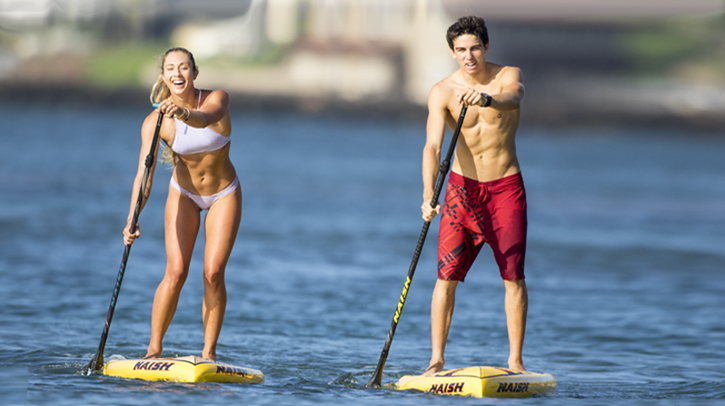
When paddling in a straight line it is best to stand 90 degrees to the board – once you catch a glide or a wave, change into surfing position – one foot forward. The ‘surf’ or offset stance is less stable so practice paddling with feet ‘offset’. The narrower the board is, the harder it is to keep balance. Boards around 28 to 30 inches offer enough stability for most people.
Stand up boards allow you to catch waves well before they actually break. They are hard to turn from the paddling position so you need to get back towards the tail to have any effect on direction. You will learn to use the paddle for trimming, steering and turning.
‘The Mal of Death’ – If you have ever had a SUP board heading towards you, out of control you will know where this ‘tag’ came from. So always wear a leg rope!
You will actually progress faster if you start out and practice on flat water.RESPECT
It is important of course with any new sport to show RESPECT and stay away from crowds and other surfers – which is not hard when you can move around so easily.
We have a strong surfing culture in Australia that is part of our heritage. Along with that culture comes a strong set of un-written rules on how to behave in the waves.
If you do not surf or do not understand these rules please DO NOT take your board into the surf or anywhere near anyone surfing. As this sport grows there needs to be much more awareness on how to behave in the surf and in the line-up.There are plenty of unriden waves up and down our coast which are perfect for Paddle Surfing.
Get out and enjoy the best that the sport has to offer – riding un-crowded breaks with no one else around!As a general rule, stay away from other surfers or swimmers when you start out in the surf. Even once you are better try to stay away from crowded spots – it is easy for the stand up rider to pick off all the best waves – NOT COOL!
Look for breaks with channels so you can easily get in and out. Stay away from sucky waves and low tide.
The beauty is that this sport doesn’t need perfect breaks – almost any wave is fun. Avoid spots with strong offshore winds as it gets really hard to paddle in windy conditions.
Before you get started doing this anywhere you MUST be a good swimmer!
Don’t go far out from shore or out on very windy days where you could get blown out to sea. If you are a beginner don’t go alone. Make sure to go where there are Lifeguards!PROGRESSINGHalf the fun of SUP surfing is learning. Get out for a session every two days and you will feel a 6 pack coming on – it really does work your core muscles.
Once you learn the basics of SUP surfing taking it to the next level so you can maximize your surf sessions is done by practicing certain things and just paddling on the flat days consistently.
Here’s a few things to do on flat days that are both fun and great training…